|
|
March 2007 |
|
Brain Waves |
|
Brain waves is the popular name for the electrical activity of the brain as recorded by medical monitors. Brain waves are the sum of electrical activity by billions of neurons in the brain. Imagine a space craft in Earth orbit, equipped with ultra-sensitive monitors that record all the speech taking place on the planet at the same time without separating it into individual conversations. A brain wave recorder is sensitive enough to pick up the minute signals from the brain but the resulting record is extremely complex. A common use for these monitors is the detection and study of sweeping effects associated with epilepsy, sleep states, coma and brain death. The most common brain wave detector is the Electroencephalograph, EEG for short. A number of EEG electrodes are placed on the scalp. The signal picked up by the electrodes (on the order of 10 uVolt) is amplified and recorded. |
Comparison of the signal at different electrodes may indicate the location of a certain activity. This may be useful in locating brain lesions as well as assisting in brain research. Early EEG monitors date to the late 19th century. Clinical EEG devices are relatively inexpensive and commonly found in most major clinical and medical research centers. The main draw-back of the EEG is its poor ability to localize the source of activity in 3 dimensions (how far it is inside the brain). Another monitor, the Magnetoencephalograph (MEG), provides a far better spatial resolution. MEG measures the magnetic fields radiated by the brain. It is a more recent technology, using sophisticated sensors. The resulting signal is often processed by a battery of powerful digital signal processors. Consequently, MEG is more expensive and not yet as common a clinical tool as the EEG. |
|
Electronic Product Development Hardware - Firmware - HDL - PCB Layout
www.sigintelec.com |
|
Each letter is substituted for another letter of the alphabet in this pearl of wisdom: SFJEAXMB AT YTMX VT BUQIX
UCBVTMD VUQE PCCLRXAEXBB. Q. O. I. VQDFTM DIY pHow accurately can you calculate p in 5 iterations? Challenge yourself – try using only the pythagorean theorem and the fact that a unilateral triangle has three 60° angles. |
p Did you know that March 14 is p day? The ratio between a circle’s area and its circumference is often approximated by a fraction. An Egyptian estimate from the middle kingdom era put p as 256/81 (3.16) and a 19th century B.C. Babylonian text cited the average between 223/71 and 22/7 (3.1419). In reality, p is an irrational number. Using numerical methods and a super-computer, p was recently approximated to over a trillion decimal places. |
|
20% of all working persons in BC are self-employed. 32% of the self-employed reported working 50 hours a week or more. Only 5% of all employees reported working as much. |
|
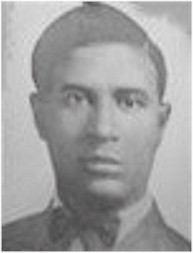
Garrett Augustus Morgan |
|
|
Waiting for a green light |
| Not everyone has to wait for the light to change. Many intersections are equipped with pre-emption systems. A pre-emption system detects the approach of an authorized vehicle and changes the light to green. Pre-emption systems are usually reserved for emergency vehicles, public busses and trams. Since it is necessary to allow some time for traffic to clear the intersection ahead of the pre-empting vehicle, it is best to transmit the signal ahead of time. However, if a traffic light is pre-empted from far away, it must know the direction and location of the activating vehicle. Some current systems use a strobe | light either in the visible or the IR range as the transmitter. These systems, as well as others based on very short range RF links, rely on line-of-sight communication. In order to speed the operation, the receiver is placed either ahead of the intersection or on a high pole. More sophisticated pre-emption made their appearance in recent years. They incorporate tracking the pre-empting vehicle direction and location using GPS, coding the vehicle messages to determine priority (ambulance over bus, etc.). Some even have a bus schedule and turn green only for late busses. |
|
|
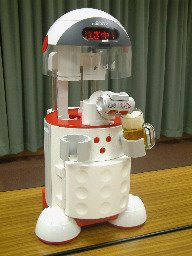
BeerBots at your service Unsteady hands? fear not - help is on the way. The BeerBot on the left is employed by Asahi Breweries in Japan. It can open a can and pour a glass with a perfect head – guaranteed. Unopened cans are stored in its belly (it’s a fridge). If you prefer German wheat beer, Hermann the Barman was designed to assist you. Hermann, the brainchild of a group of students in the Technical University of Darmstadt and their professor, takes 1 minutes and 11 seconds to pour a pint with –you guessed it – a perfect head. The development team abided by a £53 budget limit, raising hopes of impending mass-production. Are you a thirsty engineer in need of a challenge? Evolution Robotics makes a rolling platform with a mounting frame for a laptop and software. Several robotics accessories are available from the vendor – build your own BeerBot! |
Hints for DIY p:1. Place a hexagon in the circle and cut it into 60° triangles. 2. Iterate by cutting the triangles into right-angle triangles. |
Would you like a company or a project
featured? Suggestions or corrections? Please e-mail us at coffeebreak@sigintelec.com |
|
Hi-Tech Coffee Break is a free publication created and distributed by Signal Integrity Electronics. To subscribe to the printed edition, please fill the form on the right . |